
|
GROUP |
2 |
HERBICIDE |
OLYMPUS® HERBICIDE
COMMERCIAL
Wettable Granules
REGISTRATION NO: 32755 PEST CONTROL PRODUCTS ACT
ACTIVE INGREDIENT:
propoxycarbazone-sodium ............. 70%
Warning, contains the allergen milk
READ THE LABEL AND BOOKLET BEFORE USING
NET CONTENTS: 42 g – Bulk
Bayer CropScience Inc.
200-160 Quarry Park Blvd. SE
Calgary, Alberta T2C 3G3
www.cropscience.bayer.ca
Product Information: 1-888-283-6847
In case of spills, poisoning or fire,
telephone emergency response number 1-800-334-7577 (24 HOURS A DAY).
OLYMPUS® Herbicide
| TABLE OF CONTENTS: | SECTION NUMBER: |
|---|---|
| GENERAL INFORMATION | |
| The Product | 1 |
| SAFETY AND HANDLING | |
| Precautions, Protective Clothing and Equipment, and Re-Entry Restrictions | 2 |
| First Aid and Toxicological Information | 3 |
| Environmental Hazards | 4 |
| Storage | 5 |
| Disposal and Decontamination | 6 |
| Notice to User | 7 |
| DIRECTIONS FOR USE | |
| Crops and Application Timing | 8 |
| Weeds Controlled and Application Rate | 9 |
| Application Instructions and Cautions | 10 |
| Livestock Feeding and Pre-Harvest Intervals | 11 |
| Rotational Crop Recommendations | 12 |
| Mixing Instructions | 13 |
| Sprayer Cleanup | 14 |
| Herbicide Resistance Management | 15 |
For More Information, Contact:
Product Information: 1-888-283-6847
Bayer
CropScience Inc.
200-160 Quarry Park Blvd. SE
Calgary, Alberta T2C 3G3
www.cropscience.bayer.ca
GENERAL INFORMATION
|
Section 1: The Product |
OLYMPUS® Herbicide is a selective pre-plant and pre-emergence herbicide which when applied in a tank mixture with glyphosate controls several broadleaf and grassy weeds in Spring, Durum and Winter wheat.
SAFETY AND HANDLING
|
Section 2: Precautions, Protective Clothing and Equipment, and Re-entry Restrictions |
Precautions:
KEEP OUT OF REACH OF CHILDREN. Harmful if swallowed. Avoid contact with skin, eyes or clothing. Wash thoroughly with soap and water after handling and before eating, drinking or smoking. Remove and wash contaminated clothing before reuse.
If this pest control product is to be used on a commodity that may be exported and you require information regarding Maximum Residue Limits for an importing country, please contact Bayer CropScience Inc. at 1-888-283-6847 or www.cropscience.bayer.ca.
DO NOT apply this product in a way that this product will contact workers or other persons, either directly or through drift. Only handlers wearing personal protective equipment may be in the area being treated during application.
Protective Clothing and Equipment:
To minimize exposure, the following precautions should be followed:
· Protective Clothing and Equipment: During mixing, loading, application, clean-up and repair, workers and handlers must wear long-sleeved shirt and long pants, chemical-resistant gloves and shoes plus socks. Chemical-resistant gloves are not required inside a closed cab or closed cockpit during application. Change contaminated clothing daily and wash before reusing.
· DO NOT handle product with bare hands. Chemical resistant gloves significantly reduce hand exposure. ALWAYS wear gloves for mixing/loading operations and when making sprayer and nozzle repairs and adjustments. DO NOT USE LEATHER OR CLOTH GLOVES.
· Rinse gloves with soap and water before removal, and wash hands thoroughly before eating, smoking or drinking.
· Clean protective equipment daily.
· Discard clothing or other absorbent materials that have been drenched or heavily contaminated with this product’s concentrate. DO NOT reuse them.
· Users should remove clothing immediately if pesticide gets inside. Then wash thoroughly and put on clean clothing.
· Apply only when the potential for drift to areas of human habitation or areas of human activity (such as houses, cottages and recreational areas) is minimal. Take into consideration wind speed, wind direction, temperature inversions, application equipment and sprayer settings.
Re-Entry Restriction:
DO NOT enter or allow worker entry into treated areas during the Restricted-Entry Interval (REI) of 12 hours.
|
Section 3: First Aid and Toxicological Information |
FIRST AID: Take container, label or product name and Pest Control Product Registration Number with you when seeking medical attention.
If swallowed: Call a poison control centre or doctor immediately for treatment advice. Have person sip a glass of water if able to swallow. Do not induce vomiting unless told to do so by a poison control centre or doctor. Do not give anything by mouth to an unconscious person.
If on skin or clothing: Take off contaminated clothing. Rinse skin immediately with plenty of water for 15–20 minutes. Call a poison control centre or doctor for treatment advice.
If inhaled: Move person to fresh air. If person is not breathing, call 911 or an ambulance, then give artificial respiration, preferably by mouth-to-mouth, if possible. Call a poison control centre or doctor for further treatment advice.
If in eyes: Hold eye open and rinse slowly and gently with water for 15–20 minutes. Remove contact lenses, if present, after the first 5 minutes, then continue rinsing eye. Call a poison control centre or doctor for treatment advice.
TOXICOLOGICAL INFORMATION: No specific antidote is available. Treat symptomatically.
|
Section 4: Environmental Hazards |
TOXIC to aquatic plants and non-target terrestrial plants. Observe spray buffer zones specified under DIRECTIONS FOR USE.
To reduce runoff from treated areas into aquatic habitats avoid application to areas with a moderate to steep slope, compacted soil, or clay.
Avoid application when heavy rain is forecast.
Contamination of aquatic areas as a result of runoff may be reduced by including a vegetative strip between the treated area and the edge of the water body.
USE ONLY FOR RECOMMENDED PURPOSES AND AT RECOMMENDED RATES.
|
Section 5: Storage |
Keep in original container during storage.
Store in a cool, dry place away from feeds, seeds, fertilizers, plants and foodstuffs.
Do not use or store in or around the home.
|
Section 6: Disposal AND DECONTAMINATION |
Recyclable Container Disposal: Do not reuse this container for any purpose. This is a recyclable container, and is to be disposed of at a container collection site. Contact your local distributor/dealer or municipality for the location of the nearest collection site. Before taking the container to the collection site:
1. Triple- or pressure-rinse the empty container. Add the rinsings to the spray mixture in the tank.
2. Make the empty, rinsed container unsuitable for further use.
If there is no container collection site in your area, dispose of the container in accordance with provincial requirements.
Returnable Container Disposal: Do not reuse this container for any purpose. For disposal, this empty container may be returned to the point of purchase (distributor/dealer).
Returnable-refillable Container Disposal: For disposal, this container may be returned to the point of purchase (distributor/dealer). It must be refilled by the distributor/dealer with the same product. Do not use this container for any other purpose.
Disposal of Unused, Unwanted Product: For information on disposal of unused, unwanted product, contact the manufacturer or the provincial regulatory agency. Contact the manufacturer and the provincial regulatory agency in case of a spill, and for cleanup of spills.
|
Section 7: Notice to User |
NOTICE TO USER:
This pest control product is to be used only in accordance with the directions on the label.
It is an offence under the Pest Control Products Act to use this product in a way that is inconsistent with the directions on the label.
DIRECTIONS FOR USE
|
Section 8: CROPS and Application TIMING |
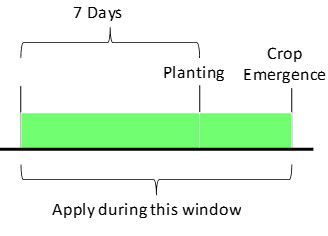
OLYMPUS Herbicide can be applied up to 1 week prior to planting Spring, Durum and Winter wheat, or immediately after planting but prior to crop emergence. DO NOT apply to crops under sown with legume species.
|
Section 9: Weeds Controlled and Application Rate |
- OLYMPUS Herbicide must always be applied in a tank mixture with glyphosate1.
- OLYMPUS Herbicide + glyphosate can be applied prior to planting or immediately after planting but prior to crop emergence in Spring, Durum and Winter wheat.
- Early weed removal leads to improved crop yield and quality.
|
Application Timing |
Product |
Rate |
Weed Species |
Recommended Weed Stage at Application |
|
Preplant or postplant preemergence |
OLYMPUS Herbicide + glyphosate1 |
10 g a.i./ha/14.3 g/ha + glyphosate at 450 g a.e./ha–900 g a.e./ha
|
Barley, volunteer |
less than 15 cm in height |
|
Canada fleabane |
less than 8 cm in height |
|||
|
Canola, volunteer2,4 |
1-leaf stage to 4-leaf stage |
|||
|
Cleavers |
less than 15 cm in height |
|||
|
Common ragweed |
less than 8 cm in height |
|||
|
Downy brome4 |
less than 15 cm in height |
|||
|
Flax, volunteer |
less than 15 cm in height |
|||
|
Flixweed |
less than 15 cm in height |
|||
|
Giant foxtail |
less than 15 cm in height |
|||
|
Green foxtail |
less than 15 cm in height |
|||
|
Hemp-nettle |
less than 15 cm in height |
|||
|
Japanese brome |
Up to and including the 2-leaf stage |
|||
|
Kochia |
less than 15 cm in height |
|||
|
Lady’s-thumb |
less than 15 cm in height |
|||
|
Lamb’s-quarters |
less than 15 cm in height |
|||
|
Persian darnel |
less than 15 cm in height |
|||
|
Redroot pigweed |
less than 15 cm in height |
|||
|
Russian thistle |
less than 15 cm in height |
|||
|
Stinkweed |
less than 15 cm in height |
|||
|
Wheat, volunteer |
less than 15 cm in height |
|||
|
Wild buckwheat |
less than 8 cm in height and less than 3-leaf stage |
|||
|
Wild mustard |
less than 15 cm in height |
|||
|
Wild oats |
less than 15 cm in height |
|||
|
Foxtail barley (seedling to heading)3,4 |
||||
1 Present as isopropylamine, dimethylamine, mono-ammonium, diammonium, trimesium or potassium salt.
2 Including glyphosate, glufosinate-ammonium tolerant Canola varieties.
3 900 g a.e./ha glyphosate rate required for control of Foxtail barley.
4 For more consistent control of subsequent flushes, follow an application of OLYMPUS Herbicide + glyphosate with an in-crop application of VARRO® Herbicide. Refer to the VARRO Herbicide label for additional weeds controlled.
· Consult the glyphosate label for further instructions regarding directions for use, restrictions and precautions, and always observe the largest (most restrictive) spray buffer zone of the products involved in the tank mixture.
· Rainfall within 4 hours of application may reduce effectiveness.
Section 10: Application Instructions and Cautions
· Apply only once per crop cycle (in the fall or spring).
·
For
best results, apply to emerged, young, actively growing weeds. Weed control may
be reduced when weeds are under stress due to severe weather conditions,
drought, very cold temperatures, etc. Weed control may be reduced if herbicide
application is made under dry, dusty conditions, especially in wheel track
areas.
· Under cool and/or dry conditions activity may be reduced or delayed. Weed control may also be reduced if application is made when weeds are dust covered or in the presence of heavy dew, fog, or mist/rain.
· Follow directions under SECTIONS 8, 9 and 10 for the correct rate and timing of application.
· Avoid contact with desirable plants or crops either from direct application or from spray drift as severe damage may occur.
· As this product is not registered for the control of pests in aquatic systems, DO NOT use to control aquatic pests.
· DO NOT contaminate irrigation or drinking water supplies or aquatic habitats by cleaning of equipment or disposal of wastes.
· This product may be tank mixed with a fertilizer, a supplement, or with registered pest control products, whose labels also allow tank mixing, provided the entirety of both labels, including Directions For Use, Precautions, Restrictions, Environmental Precautions, and Spray Buffer Zones are followed for each product. In cases where these requirements differ between the tank mix partner labels, the most restrictive label must be followed. Do not tank mix products containing the same active ingredient unless specifically listed on this label.
· In some cases, tank mixing pest control products can result in reduced pesticide efficacy or increased host crop injury. The user should contact Bayer CropScience Inc. at 1-888-283-6847 or www.cropscience.bayer.ca for information before applying any tank mix that is not specifically recommended on this label.
· Bayer CropScience Inc. has not fully assessed performance (efficacy) and/or crop tolerance (phytotoxicity) of all potential tank mixes under all environmental conditions or for all crop varieties. Tank mixes that are not specifically listed on this label should be tested on a small area first, under local conditions and using standard practices, to confirm the tank mix is suitable for widespread application.
· To determine the physical compatibility of this product with other products, use a jar test.
· Always read and follow label directions including WAMLEGS mixing order.
SPRAY BUFFER ZONES:
Use of the following spray methods or equipment DO NOT require a spray buffer zone: hand-held or backpack sprayer and spot treatment.
The spray buffer zones specified in the table below are required between the point of direct application and the closest downwind edge of sensitive terrestrial habitats (such as grasslands, forested areas, shelter belts, woodlots, hedgerows, riparian areas and shrublands) and sensitive freshwater habitats (such as lakes, rivers, sloughs, ponds, prairie potholes, creeks, marshes, streams, reservoirs and wetlands).
|
Method of Application |
Crop |
Spray Buffer Zones (metres) Required for the Protection of: |
|
|
Terrestrial Habitat |
|||
|
Field Sprayer |
Wheat (winter) |
1 |
|
|
Aerial |
Wheat (winter) |
Fixed wing |
20 |
|
Rotary wing |
15 |
||
When tank mixes are permitted, consult the labels of the tank mix partners and observe the largest (most restrictive) spray buffer zone of the products involved in the tank mixture and apply using the coarsest spray (ASABE) category indicated on the labels for those tank mix partners.
The spray buffer zones for this product can be modified based on weather conditions and spray equipment configuration by accessing the Spray Buffer Zone Calculator on the Pest Management Regulatory Agency web site.
FIELD SPRAYER APPLICATION:
· DO NOT apply during periods of dead calm. Avoid application of this product when winds are gusty. DO NOT apply with spray droplets smaller than the American Society of Agricultural Engineers (ASABE) coarse classification. Boom height must be 60 cm or less above the crop or ground.
· Application of OLYMPUS Herbicide should be made using a minimum of 46.8 litres of water per hectare, at a pressure of 275 kPa, or 310 kPa if using check valves, and at a ground speed of 6–8 kph.
· When tank mixing OLYMPUS Herbicide with a tank mix partner, ensure you read the tank mix partner label for minimum water recommendations.
· The use of 80° or 110° flat fan nozzles is recommended for optimum spray coverage.
· Do not use flood jet nozzles, controlled droplet application equipment or SPRAFOIL equipment.
· Uniform, thorough coverage is important to obtain consistent weed control. Higher water volumes should be used under dense crop and weed canopies to ensure thorough coverage of the target weeds.
· Avoid overlapping; shut off spray boom while starting, turning, slowing or stopping to prevent crop injury from over-application.
AERIAL APPLICATION:
· DO NOT apply during periods of dead calm. Avoid application of this product when winds are gusty. DO NOT apply when wind speed is greater than 16 km/h at flying height at the site of application. DO NOT apply with spray droplets smaller than the American Society of Agricultural Engineers (ASABE) coarse classification. To reduce drift caused by turbulent wingtip vortices, the nozzle distribution along the spray boom length MUST NOT exceed 65% of the wing- or rotorspan.
· Apply OLYMPUS Herbicide (ONLY with the recommended tank mix partners that are registered for aerial use) in no less than 28.1 litres of water per hectare at a pressure no less than 300 kPa.
· Apply only by fixed-wing or rotary aircraft equipment which has been functionally and operationally calibrated for the atmospheric conditions of the area and the application rates and conditions of this label.
· Label rates, conditions and precautions are product specific. Read and understand the entire label before opening this product. Apply only at the rate recommended on this label.
· Ensure uniform application. To avoid streaked, uneven or overlapped application, use appropriate marking devices.
Aerial Use Precautions:
· Read and understand the entire label before opening this product. If you have questions, call Bayer CropScience Inc. at 1-888-283-6847 or obtain technical advice from the distributor or your provincial agricultural representative.
· Apply only when meteorological conditions at the treatment site allow for complete and even crop coverage. Apply only under conditions of good practice specific to aerial application as outlined in the National Aerial Pesticide Application Manual, developed by the Federal/Provincial/Territorial Committee on Pest Management and Pesticides.
· Do not apply to terrain where there is a potential for surface run-off to enter aquatic systems.
· Do not apply if rain is expected within 1 hour after spraying. If tank mixing, consult the tank mix partner label and respect the most restrictive interval.
Aerial Operator Precautions:
· Do not allow the pilot to mix chemicals to be loaded onto the aircraft. Loading of premixed chemicals with a closed system is permitted.
· It is desirable that the pilots have communication capabilities at each treatment site at the time of application.
· The field crew and the mixer/loaders must wear chemical resistant gloves, coveralls and goggles or face shield during mixing/loading, cleanup and repair. Follow the more stringent label precautions in cases where the operator precautions exceed the generic label recommendations on the existing ground boom label.
· All personnel on the job site must wash hands and face thoroughly before eating and drinking.
· Protective clothing, aircraft cockpit and vehicle cabs must be decontaminated regularly.
Product Specific Precautions:
· Read and understand the entire label before opening this product. If you have questions, call the manufacturer at 1-888-283-6847 or obtain technical advice from the distributor or your provincial agricultural representative.
|
Section 11: Livestock Feeding and Pre-harvest Intervals |
DO NOT harvest Wheat for grain or straw within 71 days of application.
If tank mixing, always respect the maximum Pre-Harvest Interval stated on the labels of all the tank mix products.
|
Section 12: Rotational Crop Recommendations |
OLYMPUS Herbicide breakdown in the soil is due mainly to microbial activity. It can be affected by soil temperature and moisture. Conditions that accelerate the breakdown of OLYMPUS Herbicide include adequate soil moisture and adequate soil temperatures to support microbial activity. Likewise, OLYMPUS Herbicide breakdown can be slowed under dry, cold conditions. When making rotational cropping decisions, soil moisture and soil temperature conditions since application should be considered.
Only the following crops have been field tested to indicate they may be safely planted at the prescribed interval after an application of OLYMPUS Herbicide. To avoid the possibility of injury to subsequent crops after an application of the recommended rate of OLYMPUS Herbicide, follow the crops and replanting interval which appear on this label, and if tank mixing on the label of the tank mix partner, and always observe the most restrictive replanting interval. A field bioassay must be conducted the year prior to growing any other crop of interest to confirm crop safety.
Crop |
Replanting Interval |
|
Barley, spring Canola* Lentils* Peas, field* Wheat (spring, durum, winter) Oats Flax Soybeans Dry beans* |
10 months10 months 10 months 10 months 0 month 12 months 12 months 11 months 11 months |
*Do not apply more than two Group 2 herbicides at full rates in the season prior to replanting Canola and Pulse crops. Follow instructions under SECTION 15 of this label.
|
Section 13: Mixing Instructions |
OLYMPUS Herbicide must be applied with properly calibrated and clean sprayer equipment.
Prior to adding OLYMPUS Herbicide to the spray tank, ensure that the spray tank is thoroughly clean (see SECTION 14 “Sprayer Cleanup”). In-line strainers and nozzle screens should be clean and 50 mesh or courser.
1. Fill the spray tank ¼ to ½ full with clean water and begin agitation or bypass.
2. Add the appropriate rate of OLYMPUS Herbicide, as specified under SECTION 8, directly to the spray tank. Maintain sufficient agitation during both mixing and application.
3. Add tank mix partner.
4. Fill the spray tank with balance of water required.
5. Maintain sufficient agitation during both mixing and application of OLYMPUS Herbicide.
OLYMPUS Herbicide may settle if left standing without agitation. If the spray solution is allowed to stand for one hour or more, re-agitate the spray solution for a minimum of 10 minutes before application.
|
Section 14: Sprayer Cleanup |
Before and after using OLYMPUS Herbicide always complete a thorough cleaning of the spray tank, lines and filters. The following procedures are recommended:
1. Drain the tank completely, and then wash out tank, boom and hoses with clean water. Drain again.
2. Half fill the tank with clean water and add ammonia (i.e., 3% domestic ammonia solution) at a dilution rate of 1% (i.e., 1 litre of domestic ammonia for every 100 litres of rinsate). Complete filling of the tank with water. Agitate/recirculate and flush through boom and hoses. Leave agitation on for 10 minutes. Drain tank completely.
3. Repeat step 2.
4. Remove nozzles and screens and soak them in a 1% ammonia solution. Inspect nozzles and screens and remove visible residues.
5. Flush tank, boom, and hoses with clean water.
6. Inspect tank for visible residues. If present, repeat step 2.
7. Dispose of rinsings in accordance with provincial regulations.
|
Section 15: Herbicide Resistance Management |
For resistance management, OLYMPUS Herbicide is a Group 2 herbicide. Any weed population may contain or develop plants naturally resistant to OLYMPUS Herbicide and other Group 2 herbicides. The resistant biotypes may dominate the weed population if these herbicides are used repeatedly in the same field. Other resistance mechanisms that are not linked to site of action, but specific for individual chemicals, such as enhanced metabolism, may also exist. Appropriate resistance-management strategies should be followed.
To delay herbicide resistance:
1. Where possible, rotate the use of OLYMPUS Herbicide or other Group 2 herbicides within a growing season (sequence) or among growing seasons with different herbicide Groups that control the same weeds in a field.
2. Use tank mixtures with herbicides from a different group when such use is permitted. To delay resistance, the less resistance-prone partner should control the target weed(s) as effectively as the more resistance-prone partner.
3. Herbicide use should be based on an integrated pest management program that includes scouting, historical information related to herbicide use and crop rotation, and considers tillage (or other mechanical), cultural (for example, higher crop seeding rates; precision fertilizer application method and timing to favour the crop and not the weeds), biological (weed-competitive crops or varieties)and other management practices.
4. Monitor weed populations after herbicide application for signs of resistance development (for example, only one weed species on the herbicide label not controlled). If resistance is suspected, prevent weed seed production in the affected area if possible by an alternative herbicide from a different group.
5. Prevent movement of resistant weed seeds to other fields by cleaning harvesting and tillage equipment when moving between fields, and planting clean seed.
6. Have suspected resistant weed seeds tested by a qualified laboratory to confirm resistance and identify alternative herbicide options.
7. Contact your local extension specialist or certified crop advisors for any additional pesticide resistance-management and/or integrated weed-management recommendations for specific crops and weed biotypes.
For further information or to report suspected resistance contact Bayer CropScience Inc. via internet at www.cropscience.bayer.ca or telephone at 1-888-283-6847.
Bayer, Bayer Cross, Olympus® and Varro® are trademarks of Bayer Group. Used under license. Bayer CropScience Inc. is a member of CropLife Canada. ©2025. All rights reserved.